Systems are parts working together. Many things in science are systems, and in Biology the main system we study is the human body.
This lesson is a great way to jump into science content at the beginning of the year. I use this lesson to introduce the Vocabulary Log. A Vocab Log is a simple graphic organizer. It is also a classroom routine of mine. I use it the entire year as part of my classroom management strategy. This is an important lesson in my class!
I use this lesson to engage students’ minds on the topic of body systems. The purpose of this lesson is to explain what a system is. Students then explore systems by researching a system and completing a graphic organizer. (5E)
In this blog post I share my tips to teach systems and introduce Vocabulary Logs:
- Lecture and Vocabulary Log
- Systems graphic organizer
- The importance of teaching systems in Biology
- Resources in Google Drive to teach this lesson
- What’s next in learning about systems?
Lecture and Vocabulary Log
This lecture only takes about 15 minutes. I present the slides and read the information. Students take notes by copying the information into their Vocabulary Log.
A Vocabulary Log is a simple graphic organizer. There is space to write the term, definition, a keyword, and draw an image.
A Vocabulary Log is a classroom system of mine that helps with vocabulary development and organization. I use this lesson to teach students how to do a Vocabulary Log at the beginning of the year. Check out my blog post How to Teach Vocabulary With a Vocabulary Log to read more about Vocab Logs.


System
Systems are parts working together to perform a function or job. There are many parts to them, then all together they work. A bicycle is an everyday example of a system. Students can relate this to more scientific examples, like the human body.
- The solar system is a group of planets that go around our sun, and how they relate to each other.
- Biology examples would be cells, organs, plants, ecosystems.
- In science, you will study chemistry. An atom has parts in it. What are the parts in the middle of the atom, with positive and neutral charges? The nucleus, with its protons and neutrons. Another part of the atom is the electrons.
- Everyday examples: gaming systems, electronics, bicycle.
- Non-living examples would be a car and a computer system. In the education system and the governmental system, there are different positions. These positions perform functions that together keep things going.
Just ask students how they got to school this morning? Chances are, they used a system. Car, bike, bus, they are all examples of systems. Walk to school? The sidewalks and roads form a bigger transportation system.
Structure
Structure is an important term in science, especially in Biology. What does the word construction mean? To build, to put something together. So structure is how something is built or put together. In Biology we ask that question a lot. What is the design? Why do our skin cells look different from our heart cells?
Function
Function means, what does it do? What is its job? When you learn about cells, we sometimes compare them to a factory. The organelles are like different workers in the factory and they all have different jobs to do. For example, the cell wall is like a security guard, letting certain things in and keeping other things out. The nucleus is like to CEO or boss of the factory. The nucleus has the instructions to tell the other parts of the cell what to do.
Component
A component is a more academic way of saying a part.
Biological Systems
Many things in science are systems. In Biology, the main system we study is the human body. The different cells, tissues, organs, and organ systems work together to do their jobs and keep us alive.
Biological systems are living things, like a plant, an organ system, an animal. More examples of biological systems include:
Circulatory system
Immune system
Muscular system
Skeletal system
Digestive system
Nervous system
Respiratory system
Male reproductive system
Female reproductive system
Any cell
Any organ
The whole body
Plants
Animals
Systems Graphic Organizer
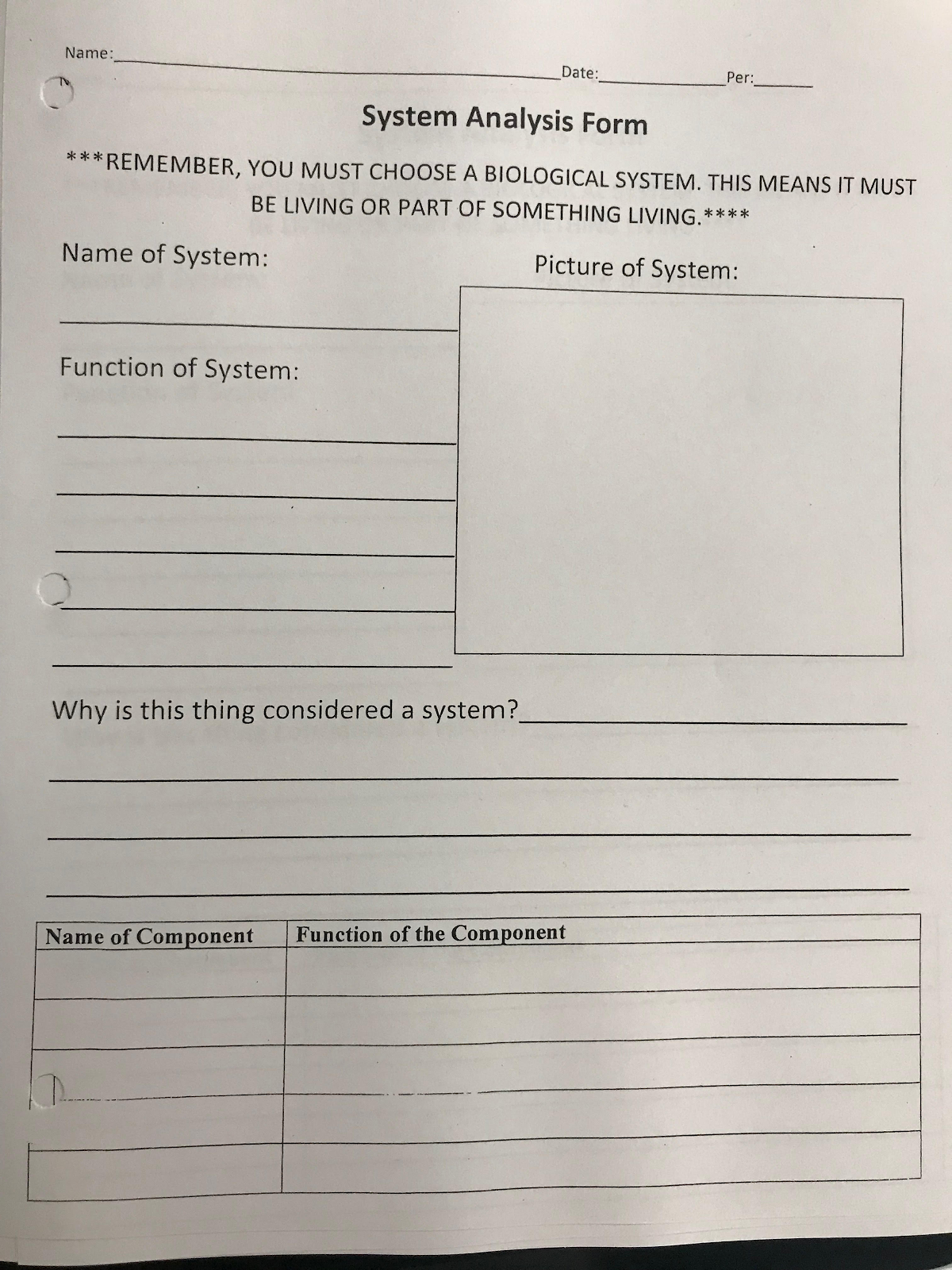
Students research a biological system and complete (another) graphic organizer. Some years I let students choose to research either a biological or non-biological system. Students love the extra freedom to choose whatever they like, and they usually enjoy doing the assignment a little more. The graphic organizer works for biological or non-biological systems.
Students use their Chromebooks to research the function of the system, and the various components. Students also draw a picture of the system. Students use Google Image search and add keywords like “science” and “diagram” to find good examples.
The system analysis form makes a great routine assignment. It is a graphic organizer that we can go back to at different times in the year. There are many opportunities to use the system analysis form in high school Biology. It would work great for cells, plant cells, animal cells, body systems, and ecology. I would use this in an Earth and Space class. It relates well to the solar system and Earth’s systems.
The Importance of Teaching Systems in Biology
Why do we learn about systems in Biology? Systems are a cross-cutting concept in science. By understanding systems, students can make connections between different natural phenomena. For example, we first learn about body systems. Then, we spiral back to the idea of systems later in the year when we study cells and ecosystems. In Chemistry, the atom is a system. In Earth and Space science, we study the geosphere, hydrosphere, atmosphere, and the solar system.
We make connections across concepts and disciplines. This activates prior knowledge. Importantly, we connect new learning and deepen our understanding.
Structure and Function are also cross-cutting concepts. Often, the way something looks or is put together, helps it do its job. This is true with cells, and structure and function come up a lot when we learn about them.
Resources in Google Drive to Teach this Lesson
Check out my Body Systems folder in Google Drive. Make a copy of the slides, notes, systems organizer, and tweak them to your needs.
Google Drive > How She Teaches > Body Systems

What’s Next in Learning About Systems?
I really enjoy teaching this lesson on systems. It is an easy way to go beyond beginning of the year stuff. It is often one of the first science content lessons I teach in the year. I especially like this lesson because it generates interesting discussion with students. They usually have a lot of prior knowledge and relevant life experience. They have a lot to contribute and usually ask interesting questions.
This lesson is my favorite way to lead into Body Systems. Check out my blog post How She Teaches Body Systems to read more about where this lesson leads. We spiral back to the idea of systems later in the year when we study cells and ecosystems.
I hope this lesson on What is a system? is helpful and saves you some time! What are your favorite ways to introduce Body Systems in your class? Let me know by leaving a comment, I would love to hear from you! If you want to read more about me and my classroom, check out the blog posts below!
14 thoughts on “How She Teaches: System, Structure, Function, Component”